
How long until a new seller is productive?
Plan for the learning time plus one full sales cycle. A new seller’s first own deal cannot close faster than your deals usually do. Write down what productive means and check it at days 30, 60 and 90.
Decide what productive means
Most arguments about a new seller start with this word. The owner means “sells as much as our best seller”. The seller means “knows the product”. You mean something in between. Before you name any date, write one sentence the three of you can check, and read it to the owner and to the seller in the same week.
A useful definition names work the seller does alone. They answer their own inquiries within the response standard, run a first conversation without help and close a deal without you on the call. Sales volume comes later and depends on things a new seller does not control yet, such as how many inquiries reach them.
Start from your own sales cycle
A seller cannot close their first deal faster than your deals usually close. Say your median sales cycle is long and the new seller starts taking inquiries in week five: their first payment arrives one cycle after that, even if they do everything right.
So the estimate has two parts. Learning time is how long until the seller starts working their own inquiries. The cycle is your median from first inquiry to payment, taken from won deals in the CRM. Add the two, and you get the earliest date to expect a deal they closed alone. Treat it as a planning figure and test it on your own numbers.
Check skills at three points
Until that date, check skills and leave revenue for later. At days 30, 60 and 90, look at real conversations and deals, and mark each skill as can do alone, can do with help or not yet.
Day 30 is about the product and the process. Day 60 is conversations with a mentor beside them. Day 90 is owning their inquiries. If the marks do not move between two checkpoints, you see it in week eight, while the plan can still change.
Each gap becomes a task with a name and a date: who teaches the skill and when you check it again. The Sales rep onboarding 30/60/90 kit has a skills map and mentor assignments for this.
What to tell the owner
Give the owner the definition, the earliest date and the three checkpoints, and leave out any promise of speed. A slow first month then reads as what your cycle predicted, and at each checkpoint the owner sees facts.
As head of sales, you own this plan. If the seller falls behind, bring the owner the marks and one proposal: more mentor time, or a narrower set of inquiries for another month.
Keep the plan where the seller can see it too. A seller who knows the earliest date stops comparing themselves with the best seller’s month, and asks for help sooner when a mark does not move.
An example with invented numbers
Example (invented numbers): a team’s median sales cycle is 35 days. A new seller starts on a Monday and leads conversations on their own inquiries from week five, around day 30. The earliest date for a first deal they close is around day 65. The owner hears that date on day one, along with the checkpoints at days 30, 60 and 90. On day 60 the skills map still shows first conversations as “with help”, so the head of sales adds two listening sessions a week with the mentor.
Do this week
By Friday, write one sentence that defines productive for your new seller and put the earliest date and the three checkpoints in your calendar.
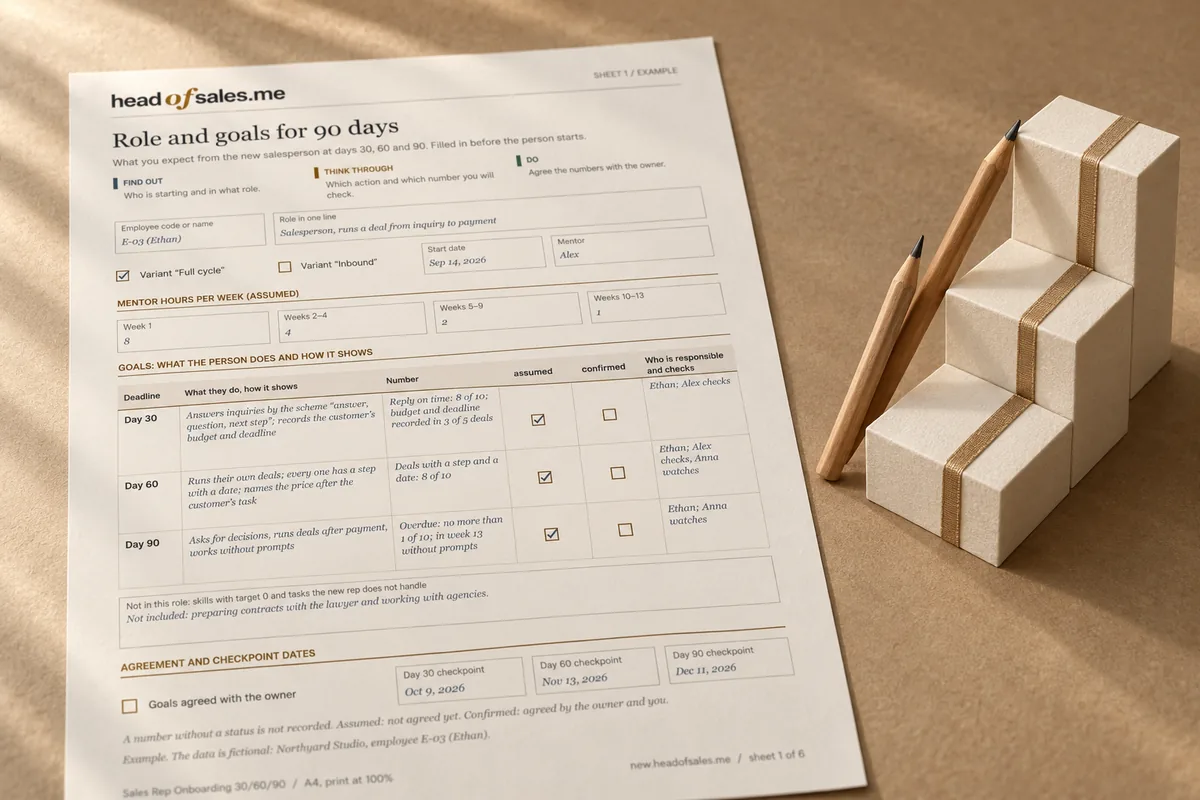
A 90-day plan for each new seller, with mentor assignments and a skills check.