
How to answer “too expensive” without a discount
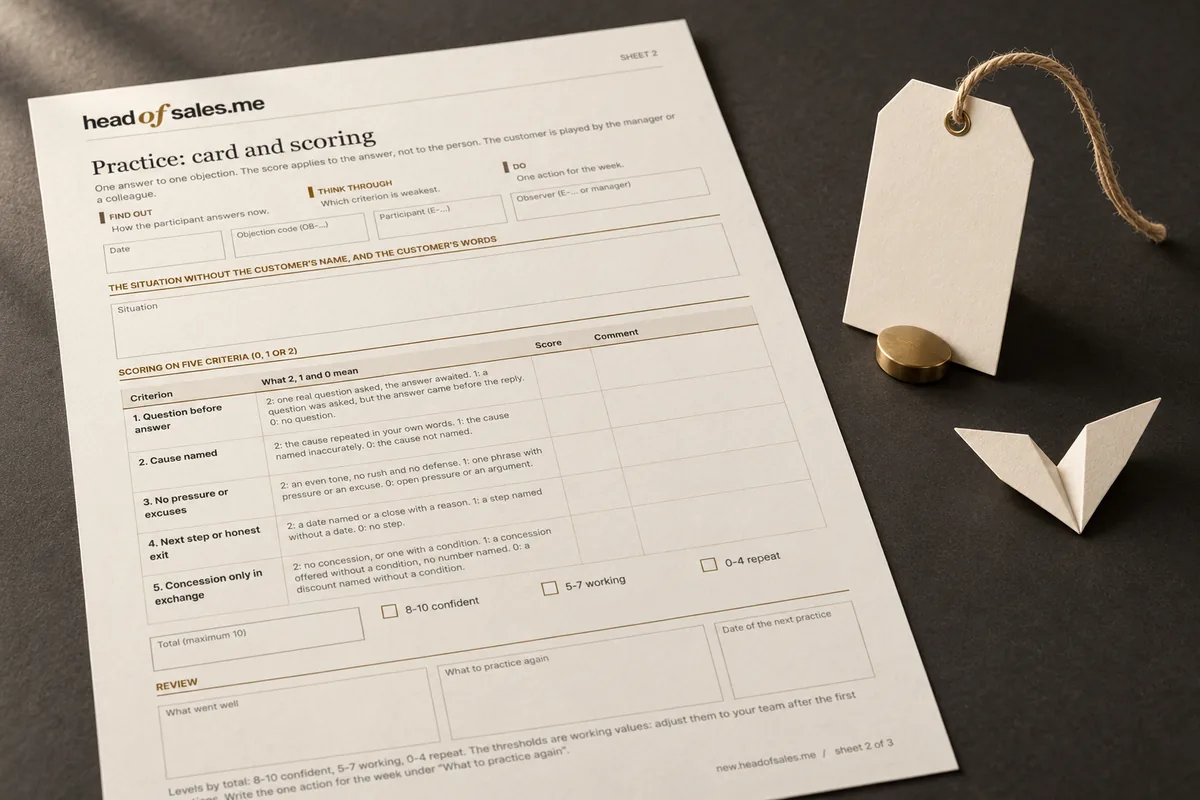
Before you answer, ask: “Compared with what?” Answer the comparison the customer names and cut scope before you cut price. A concession follows a written rule, and the customer gives something back for it. Every price conversation ends with a next step and the customer's decision date.
Ask what it is compared with
Ask one question before you say anything about price: “Compared with what?” or “Which part looks expensive to you?” Then stay quiet and let the customer answer. “Too expensive” sounds like a conclusion, and you do not know yet what it rests on. A seller who answers with a discount pays for a question they never asked.
The same two words usually stand for one of four situations:
- A cheaper quote from someone else, often for less work.
- A budget smaller than the proposal.
- Value the customer cannot see yet: they do not know what the price includes.
- No decision yet, said politely, because price is the easiest reason to name.
One answer for each situation
Another quote on the table: ask to go through it next to yours, line by line. The two prices often cover different work, and one includes installation and a warranty while the other does not. Say what your price includes in the customer's own terms and let them compare. Do not run down the other offer.
A smaller budget calls for a smaller scope at the same price per part. Offer a first stage, or part of the work now and the rest later. The customer gets a total that fits, and your prices stay the same for the next customer.
When the customer cannot see the value, go back to what they told you in the first conversation: the problem they want solved and what it costs them today. If they never told you, qualification has a gap, and a discount will not close it.
If the price hides a decision that has not been made, ask about the decision directly: “Apart from the price, is anything else holding you back?” and “By what date do you plan to decide?”
Give concessions by rule
Before the next price talk, put a concession rule on one page. It names who may offer a concession and how large it may be. It also lists what the customer gives in return: a larger order, a longer contract, payment up front or a quick decision. Give something for nothing, and the customer learns that the first price was not real.
Sellers improvise on discounts because nobody has decided for them. Once the rule is written, nobody has to guess what the manager will approve. The Objections and concessions kit has a concession rule and an objection library where the team collects the answers that worked.
End with a step and keep a log
Whatever you answered, the conversation ends with a next step that has one owner and a date, for example “call on Thursday at 11:00 to hear your decision”. Write down the decision date the customer named too, in their words. A deal that leaves a price talk with neither can sit in the pipeline for weeks.
Log every price objection in one place: the deal, what the customer compared with, what the seller said and how it ended. Once a month, read the log next to the conversion from proposal to sale. When “too expensive” keeps coming up at the proposal stage, the fix usually sits earlier. Ask about budget and alternatives in the first conversation, and size the proposal to the answer.
An example with invented numbers
Example (invented numbers): a seller sends a $6,000 proposal for an office fit-out, and the customer says it is too expensive. Asked “compared with what?”, they name a $4,500 quote. Line by line, the cheaper quote leaves out installation and the one-year warranty. The customer's budget is $5,000. The seller offers the work without the meeting room: $4,800, at the same unit prices. The customer promises to decide by Friday, and the seller books a call for Friday at 10:00.
Do this week
By Friday, write a one-page concession rule and open a shared log. Each seller adds their last two price objections and what they answered.
Answers to “too expensive” and “we will think about it” without a free discount.