
How to forecast next month's sales in a small team
Build the forecast up from the deals and show the gap to the target openly. Clean the pipeline first. List the active deals that have an amount and a decision date next month, and sort them into three versions: cautious, base and good. Check the result against win rate and pipeline coverage, then send it to the owner with the assumptions written out.
Clean the pipeline first
A forecast built on dead deals comes out too high. Run the pipeline review before you count: take the stuck deals, longest stuck first, and make one decision on each. Move it with a dated step, fix what is missing, or close it as lost with a reason.
Then filter the CRM for active deals with a decision date next month: the customer confirmed interest recently, and a next step with a date is recorded. Use the date the customer gave you. The seller's hope stays out of that field. A deal with no amount or no decision date cannot be counted, so put those on a separate list and give each seller theirs to fill in.
Sort the deals into three versions
Each seller marks their own deals, and the head of sales checks the marks against the CRM. The three totals show how wide the uncertainty is. The list shows the few deals that decide the month.
Before anyone marks a deal, write one rule per version, so the marks do not follow the mood of the week:
- Cautious: late-stage deals with a next step agreed with the customer.
- Base: the cautious deals plus those where the customer is actively choosing.
- Good: the base deals plus the remaining open deals that could still close in time.
Check it against win rate and coverage
Take your win rate for the last eight weeks: deals won divided by deals won plus lost. As a starting rule, treat it as an early figure while you have fewer than ten decided deals. Multiply next month's active pipeline by it and compare the result with the base version. A large gap sends you back to the marks or the dates.
Pipeline coverage answers a plainer question: is there enough to work with? Divide the value of active deals with a decision date next month by next month's target, and read the result next to win rate. If the team wins about one deal in three, start by testing a level of roughly three times the target.
Your sales cycle matters too. When deals usually take longer than a month, next month's sales are almost all in the pipeline already. With a shorter cycle, part of next month will come from inquiries that have not arrived yet. Estimate that part from the last three months and give it its own line, so nobody mistakes it for named deals.
Send it with the assumptions and compare
The owner gets the three totals, the deals behind each one and two lines of assumptions. Update the forecast every week, right after the pipeline review. When a total drops, write which deal moved and why.
At month end, put the forecast next to the result and note which assumption failed. Three months of these notes show which version your team usually lands on. The CRM and forecast kit includes a weekly forecast review sheet and a spreadsheet that compares the forecast with results.
An example with invented numbers
Example (invented numbers): next month's target is $40,000. After the review, 14 active deals worth $78,000 have a decision date next month. Cautious, 3 deals: $17,000. Base, 7 deals: $33,000. Good, all 14: $78,000. The eight-week win rate is 30%, 9 of 30 decided deals, and 30% of $78,000 is $23,400. That is below the base, so the head of sales rechecks the four deals that are in the base but not in the cautious version. Coverage is 1.95 against a test level of about 3.3. The sales cycle runs about three weeks, and the last three months suggest a separate line of $6,000 from inquiries still to come. The owner gets $33,000 plus $6,000 against $40,000, with the conclusion: the month depends on four deals, and more inquiries are needed now.
Do this week
Before Friday, list every active deal with a decision date next month and mark each one cautious, base or good by the written rule. Send the owner the three totals.
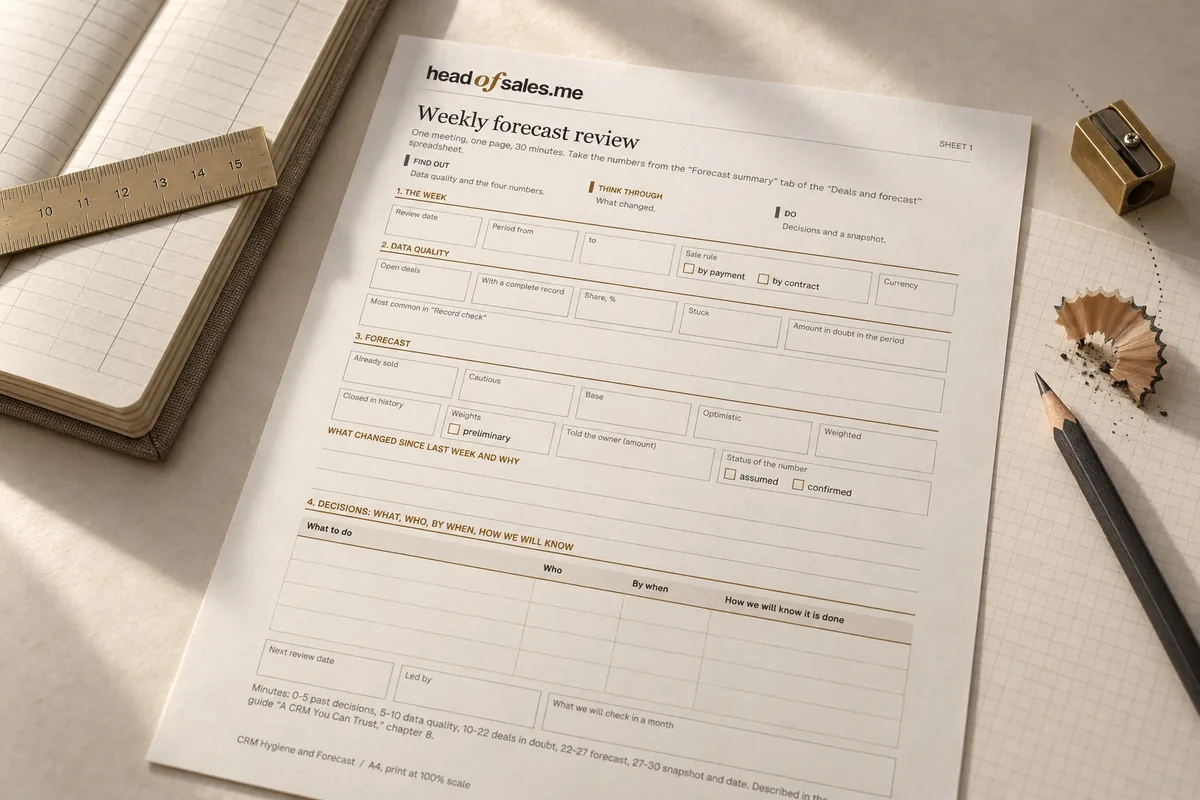
CRM rules the team follows and a forecast review you can run every week.