
How to split leads between sellers
Choose the simplest assignment rule that matches how inquiries arrive: by channel, by region, by turn or by deal size. A lead has one owner at a time, and each seller has a backup named by first name. Once a week, a CRM list of leads with no owner or no contact shows where the rule leaks.
Pick the simplest rule that fits
Most small teams get by with one of four rules. Take the one that matches how your inquiries arrive:
- By channel: one seller owns the messenger, another the website form and email. Use it when channels bring different customers or need different reply times.
- By region: for customers who expect someone who knows their city or speaks their language.
- By turn: the next inquiry goes to the next seller on the list. This works when inquiries are similar and arrive in one place.
- By deal size: large or complex inquiries go to the most experienced seller. Choose it when a few deals carry the month.
One owner at a time
A lead belongs to the person the rule gave it to, until the rule moves it. When two sellers both “keep an eye” on an inquiry in a shared inbox, usually nobody replies. Put one name in the owner field from the first minute.
Write down how a lead can move. A seller passes it on with a note, for example when the customer turns out to be from another region. A manager takes it back, also with a note, after a week with no contact. A lead that cannot move stays with someone who has stopped working it.
Look at a seller's load before you give them more leads. With many open deals and few active ones, they should revive or close what they have first. New inquiries would only bury the deals that are still alive.
Name a backup for every seller
Leads get lost while their owner is away: on leave, off sick, over a weekend. By the time the owner is back, the customer has often gone elsewhere. Name each seller's backup by first name, and give the backup access to the leads before the owner leaves.
Test the rule at the team meeting with one question: “What happens to a new inquiry on Friday evening if its owner is ill?” If nobody can answer in one sentence, the rule needs another line.
Check it in the CRM each week
Make the owner field required, and allow a change of owner only with a note. Then run one list every week: leads with no owner, and leads with no contact for a week. Five minutes with it show where the rule leaks.
Check the split per seller as well: new leads received and active deals held. A seller who takes most of the new inquiries but has few active deals is a sign to change the rule now, before the gap grows. The CRM and forecast kit has rules for required fields and an editable CRM policy you can adopt in your team.
An example with invented numbers
Example (invented numbers): three sellers share about 60 inquiries a month, most from the messenger and the website form. Leads go by turn. Clara covers for Ben, Ben for Anna, Anna for Clara. After the first week the list shows four leads with no contact for a week. All four belong to Ben, who was on leave, and Clara never saw them because nobody passed them on. The rule gets one more line: the day before a leave, the owner's open leads move to the backup with a note.
Do this week
On Thursday, write the assignment rule in one sentence and name a backup for each seller. Then run your first list of leads with no owner or no contact for a week.
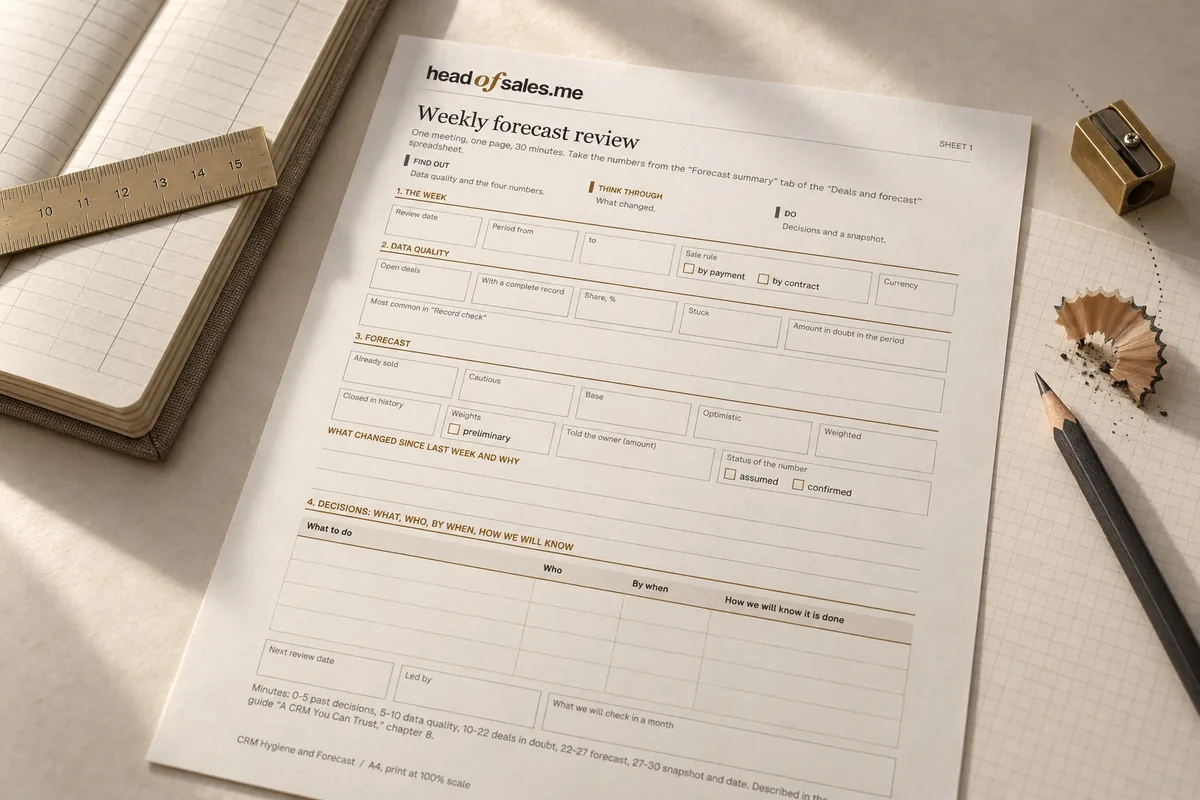
CRM rules the team follows and a forecast review you can run every week.