
How to write a sales onboarding plan
Write the plan before the seller arrives: one goal each for days 30, 60 and 90, a named mentor for every skill and three dated checkpoints where you look at real calls and deals. Judge progress by what the seller can now do alone, and leave invented quotas out of it.
Before day one
The first week goes wrong when Monday starts with a login that does not work and a hunt for someone who has time. Two hours in the week before save the first three days. Have these ready:
On Friday, send the seller a short note: when to arrive, who meets them and what the first day looks like. A new job is easier to start when Monday already has a shape.
- Access: the CRM login, email, phone and messenger accounts, the price list and the shared folder. Ask someone other than you to test each one.
- The one-page description of how you sell: who you sell to, where inquiries come from, the deal stages and the next-step rule. If it does not exist yet, write it now. The new seller will be its first real reader.
- Ten recent deals to study, five won and five lost, with links to them in the CRM.
- The mentor’s calendar: time blocked for the first two weeks, agreed with the mentor in person before you book it.
Week one
The first week is for the product, the customer and the CRM, in that order. On day one the seller reads the one-page description and asks questions the same afternoon. Write those questions down. They show you where the page is unclear.
From day two, they read and listen. Give them five recorded calls or chat threads a day, won and lost mixed, and ask for two lines on each: what the customer wanted and what the next step was. On day three they sit in on live conversations with the mentor. By Friday they can open any deal in the CRM and say what stage it is at and what happens next.
Keep them away from live inquiries this week unless your sale is very simple. A rushed first conversation teaches a seller to improvise, and you spend the next month undoing it.
Close the week with a 30-minute talk with the seller and the mentor. Ask what was unclear and what they would change in the description. Fix one thing on the page that day.
Goals for days 30, 60 and 90
Write one sentence for each checkpoint, as something a person can do. Attitudes and feelings stay out of the plan, because nobody can check them on day 60.
Under each goal, list the tasks that get the seller there. Five to eight per period is plenty. Each task has an owner and a date, like any other task in your team. Show the seller all three goals on day one.
- Day 30: knows the product and the process. Explains the offer to the mentor in five minutes, moves deals between stages correctly and writes a next step on every deal they touch.
- Day 60: leads conversations with the mentor present. Runs first calls, sends proposals the mentor has read before they go out and asks before giving a discount.
- Day 90: owns their inquiries. Gets new leads in the normal rotation, keeps every open deal with a dated next step and brings their own stuck deals to the pipeline review.
What the mentor does
In a team of three or four, the mentor is usually a working seller with their own plan. Their time is a cost, so write it into the plan. As a planning figure, start with about an hour a day in the first month, half an hour a day in the second and one hour a week in the third. Then adjust to what you see.
The mentor’s job changes every four weeks. Write the changes down, so the mentor knows when to step back.
Consider one mentor per skill instead of one mentor for everything. The seller who closes the most is not always the one who explains best. Product questions can go to whoever built the offer, CRM questions to whoever keeps it clean. If a mentor misses sessions two weeks in a row, that is yours to solve: take work off their plate or name someone else.
- Weeks 1 to 4: lets the new seller listen to their calls and explains afterwards why they said what they said.
- Weeks 5 to 8: listens while the new seller leads and gives two comments after each call, one thing to keep and one to change.
- Weeks 9 to 12: reviews the new seller’s deals once a week and stays out of the conversations.
- All 90 days: answers questions the same day, or says when they will.
Checkpoints without made-up quotas
Book days 30, 60 and 90 in the calendar now, 45 minutes each, with you, the seller and the mentor. Before each one, pick three or four real conversations and five open deals. Judge those, and leave your impression of the person outside the room.
Mark each skill on a short list as can do alone, can do with help or not yet. That is the whole scale. At day 30, a sheet full of “with help” means the plan is working. A “not yet” on the product or the CRM is the mark to act on. If you want to see how much detail is useful, the Sales rep onboarding 30/60/90 kit has a skills map and a filled example.
A revenue target in the first 90 days is usually a guess. Look up your median sales cycle. If it is longer than a month, a deal opened in week five cannot close before the 60-day checkpoint, and revenue at day 60 measures luck. Count what the seller controls: conversations led, deals with a dated next step, proposals sent after the mentor’s review, reply time on their own inquiries. Take a starting level from what your current sellers do in an ordinary week, call it a first guess and test it.
When the marks do not move between two checkpoints, change one thing: the mentor, the tasks or the inquiries the seller gets. Write down which one, and check at the next date. If the person does not fit, decide it at day 90, on the marks, with the seller in the room.
What to leave out
A plan gets heavier every time someone remembers something. Cut these before you hand it over.
- A reading list longer than the one-page description and ten deals. Product manuals can wait until a customer asks.
- Every report and setting in the CRM. Teach the five screens the seller opens daily, and the rest when they need it.
- Weeks of shadowing. After the second week, listening without leading turns into a habit, so move to supervised calls on schedule.
- Daily status reports. The CRM already shows what the seller did. Read it.
- A promise to the owner about when the seller reaches plan. Tell the owner what you will check and on which dates.
An example with invented numbers
Example (invented numbers): a company that installs office ventilation has four sellers and a median sales cycle of 35 days. A new seller, Dan, starts on a Monday. Irina, a senior seller, mentors him on calls, and the owner takes product questions. Irina agrees to 60 minutes a day for four weeks, 30 minutes for the next four and one hour on Fridays after that.
At day 30, Dan has listened to 62 calls, sat in on 11 live ones and written a next step on all 40 deals he touched. His sheet shows the product as “with help” and the CRM as “alone”. The owner asks how much Dan has sold. Irina answers that a deal opened now closes in about five weeks, so sales are a question for day 60 at the earliest.
At day 60, Dan has led 18 first calls with Irina listening and sent 7 proposals, all read by her first. Two marks are still “not yet”: a discount request and asking the customer for a decision date. The head of sales gives Dan the discount rules from the one-page description to practice and books two extra calls with Irina on the decision date.
At day 90, Dan is in the normal lead rotation, all 23 of his open deals have a dated next step, and he has closed 3. Nobody promised a number, so the 3 reads as an early result from a seller who now runs his own deals.
Do this week
By Friday, the head of sales writes the three goals for the next hire and puts a mentor’s name and minutes a week against each skill. The three checkpoints go into the calendar the same day.
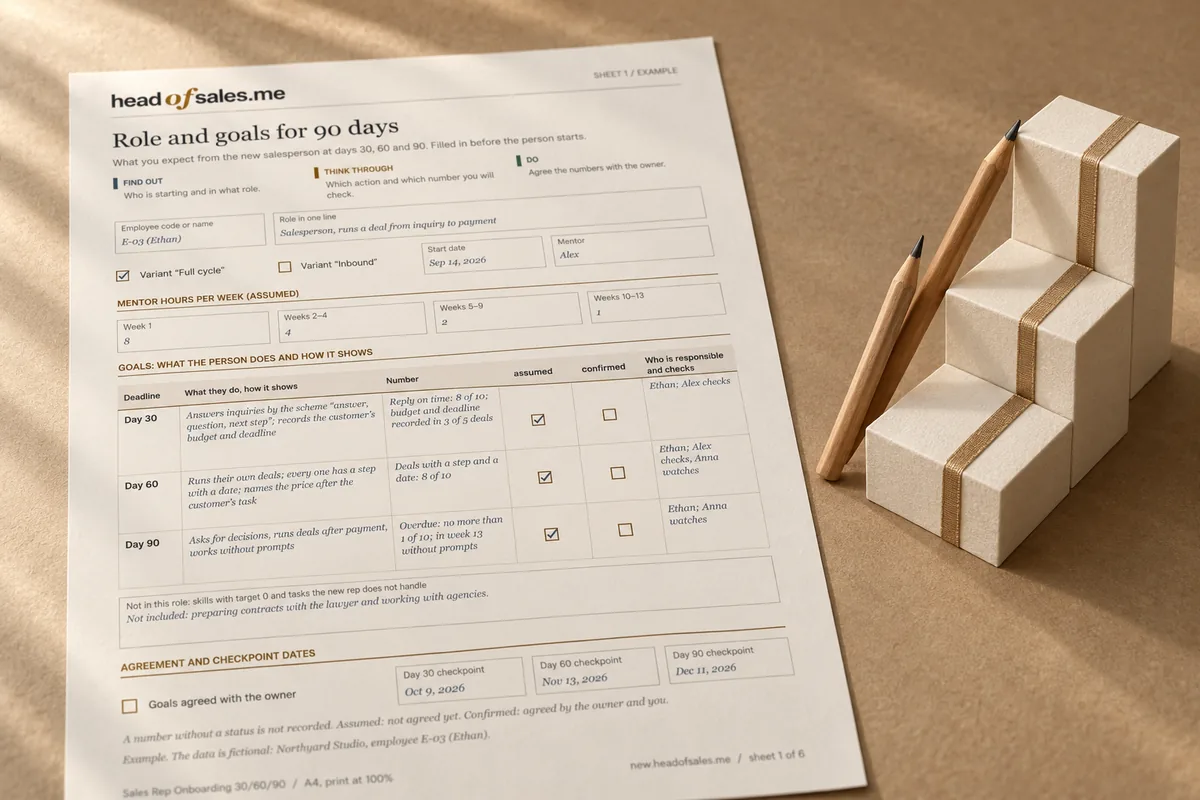
A 90-day plan for each new seller, with mentor assignments and a skills check.