
What is a good lead response time?
A good response time is one your team keeps every working day. Start from your own median for the last two weeks and set a standard per channel. Treat any faster target as a hypothesis and test it against your conversion.
Start from your own numbers
Start from your own median. A messenger inquiry and an emailed request for a quote are different situations, and so are a team of two and a team of eight, so a number borrowed from elsewhere rarely fits.
Take the inquiries from the last two weeks. For each one, the CRM holds the arrival time and the time of the first reply by a person. Find the median per channel, and count the inquiries that got no reply at all. That pair of numbers shows where you stand today.
Check that every channel lands in the CRM with its real arrival time. If phone inquiries are typed in an hour later, the clock starts late and your median looks better than what customers got.
Set a standard per channel
For each channel, choose a time your busiest working day can still meet. If your messenger median is three hours, one hour is a fair first hypothesis to test. Fifteen minutes would be a rule the team breaks on the first Monday.
The standard fits in a few lines. An automatic “we got your message” does not count as a reply: the customer is still waiting for a person.
- The channel and the working hours it covers.
- The time within which a person replies.
- The name of the person who replies and of the one who covers.
- The reply time for inquiries that arrive after hours.
Test whether faster is worth it
Any faster target stays a hypothesis until your data supports it, and conversion is where you test it. Count what share of inquiries answered within the standard became a conversation, and what share of the late ones did. Compare the two after a month.
If your own data shows a large gap, speed is worth staffing for and you can tighten the standard. If it shows none, look at what the first reply says before you push the team to answer faster.
Keep the comparison fair. Compare inquiries from the same channel and the same weeks, because a slow email inbox and a fast messenger bring different customers. A gap between channels says little about speed.
Tighten it one step at a time
Each week, track two numbers: the share of inquiries answered within the standard, which is the reply-on-time number on the weekly page, and the median response time. Use the median, not the average. One inquiry that waited all weekend pulls the average far from what a typical customer got.
Once a week, go through the misses with the people who reply and ask for the reason behind each one. Usually it is lunch or an evening nobody covered, sometimes a sick day. Each reason points to a cover gap you can close with a name.
When the share stays high for a month and nobody has to stretch, shorten the time a little and measure again. The First reply standard has 52 reply templates and a weekly control checklist for this check.
An example with invented numbers
Example (invented numbers): three people answer inquiries. Their messenger median comes out at 2 hours 40 minutes, and 9 of 120 inquiries were never answered. They set a two-hour standard on weekdays from 9:00 to 18:00 and name a backup for lunch. After a month, 88% of inquiries get a reply within two hours, and 41% of those became a conversation. Of the late ones, 27% did. The gap is large enough to test one hour next month.
Do this week
By Friday, find the median reply time per channel for the last two weeks and write a first standard with names in it.
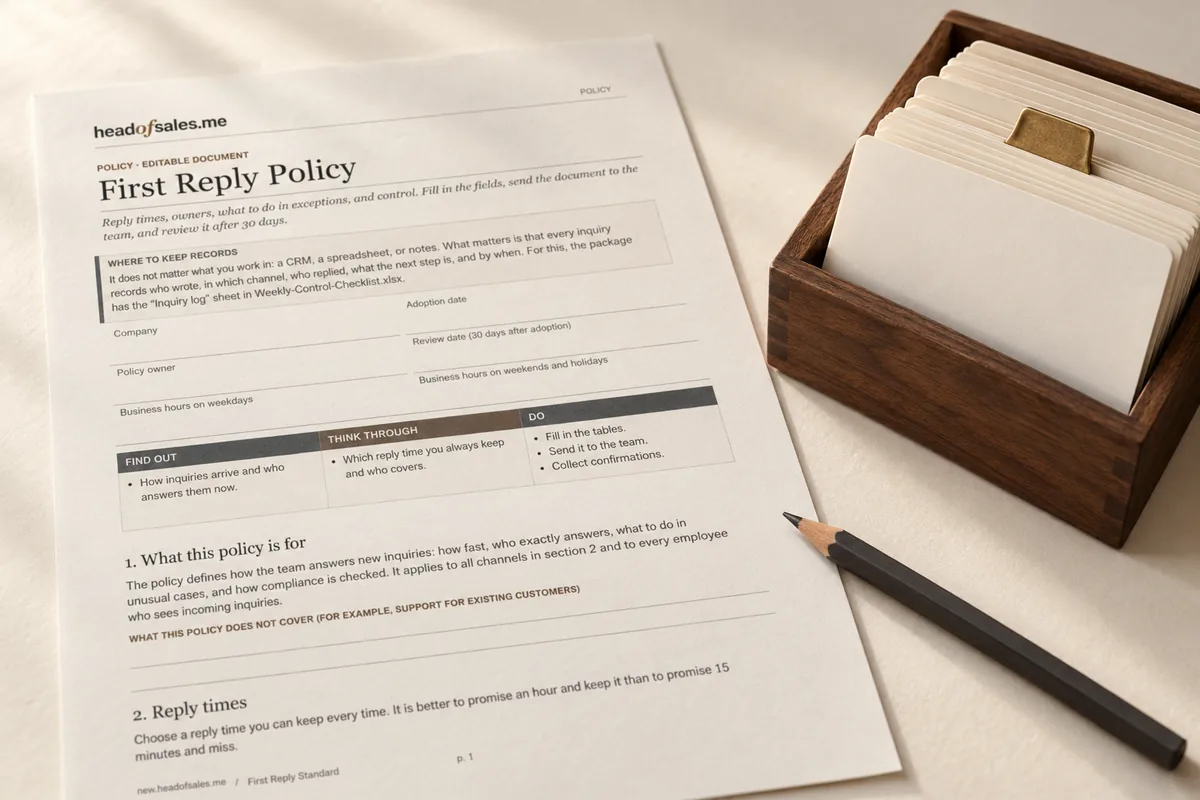
Who replies to a new inquiry, how fast and with which words.