
Lead response time
Lead response time is the time from an inquiry arriving to the first reply from a person on your team. Automatic replies do not count.

In plain words
Lead response time is how long a new inquiry waits before a person on your team answers it. The first reply is the first thing the customer learns about how you work. A useful reply starts a conversation; a slow one can send the customer to whoever answered first. For an owner, it is one of the few sales numbers a team can move within a week.
Both timestamps come from the CRM. Arrival is the moment the inquiry reached you: the form sent, the first message in a messenger, the call, answered or missed. The first reply is the first outgoing message or call by a person in that deal. Check that arrival is recorded automatically. If a seller types in a phone inquiry an hour later, the clock starts late and the wait looks shorter than it was.
Formula
Response time = first human reply − inquiry arrival
For a week or a month, report the median of all inquiries, plus the number of inquiries with no reply at all.
Why the median, not the average
| Inquiry arrived | First reply | Response time |
|---|---|---|
| Mon 09:12 | Mon 09:40 | 28 min |
| Mon 11:05 | Mon 11:20 | 15 min |
| Mon 16:50 | Tue 10:30 | 17 h 40 min |
| Tue 08:30 | Tue 08:55 | 25 min |
| Tue 14:10 | Tue 14:30 | 20 min |
How it is usually misread
- Counting the auto-reply. An instant “we got your message” makes every number look fast while the customer still waits for a person.
- Leaving out unanswered inquiries. An inquiry with no reply has no response time, so it quietly disappears from the average. Count it separately.
- No rule for evenings and weekends. Decide whether the clock stops outside working hours and write it down. Otherwise two sellers report different numbers for the same work.
Which decision it supports
Who replies to new inquiries and how fast. A slow median points to ownership: nobody is clearly responsible for the first reply. Many unanswered inquiries point to a channel nobody watches.
How to use it
Look at it weekly, by channel and by seller. One combined number hides the problem: a quick messenger and a slow email inbox average out to a figure nobody recognizes. Each person who answers a channel hears their own number as well as the team’s.
Track a second number next to the median: the share of inquiries answered within your response standard. The median is what a typical customer gets. The share is how often you keep the promise. Example (invented numbers): a median of 20 minutes with 70% inside a one-hour standard means three inquiries in ten wait longer than promised.
Then hold it up against conversion. Count how many inquiries became a conversation when the reply came within the standard, and how many when it came later. A large gap in your own data means speed is worth staffing for. If there is no gap, look at what the first reply says.
Common mistakes
- Starting the clock when the deal is created. Inquiries entered by hand then look fast. Use the time of the first incoming message or call.
- One number for all channels. A call answered live and an email answered the next morning do not belong in one median. Give each channel its own line in the report.
- Counting any outgoing message as a reply. A sticker or a “hello?” stops the clock and tells the customer nothing. Agree that a reply answers the question or asks a useful one.
- Reading only the team number. A good team median can hide one seller whose inquiries wait half a day. Every week, open the five slowest inquiries and ask what happened with each.
NEXT STEP · TOOL
By Friday, the head of sales exports last week’s inquiries from the CRM with two columns: arrival and the first reply by a person. Split them by channel. For each channel, find the median and the share answered within your current response standard. On Monday, show the table to the people who answer each channel, and agree one change for the channel with the lowest share.
Questions
Does a chatbot reply count?
Count the first reply that moves the conversation forward with a person. Track bot replies separately if you use them.
What is a good lead response time?
It depends on your channel and how your buyers choose. Start by comparing your team with its own past weeks, then set one target and check it weekly.
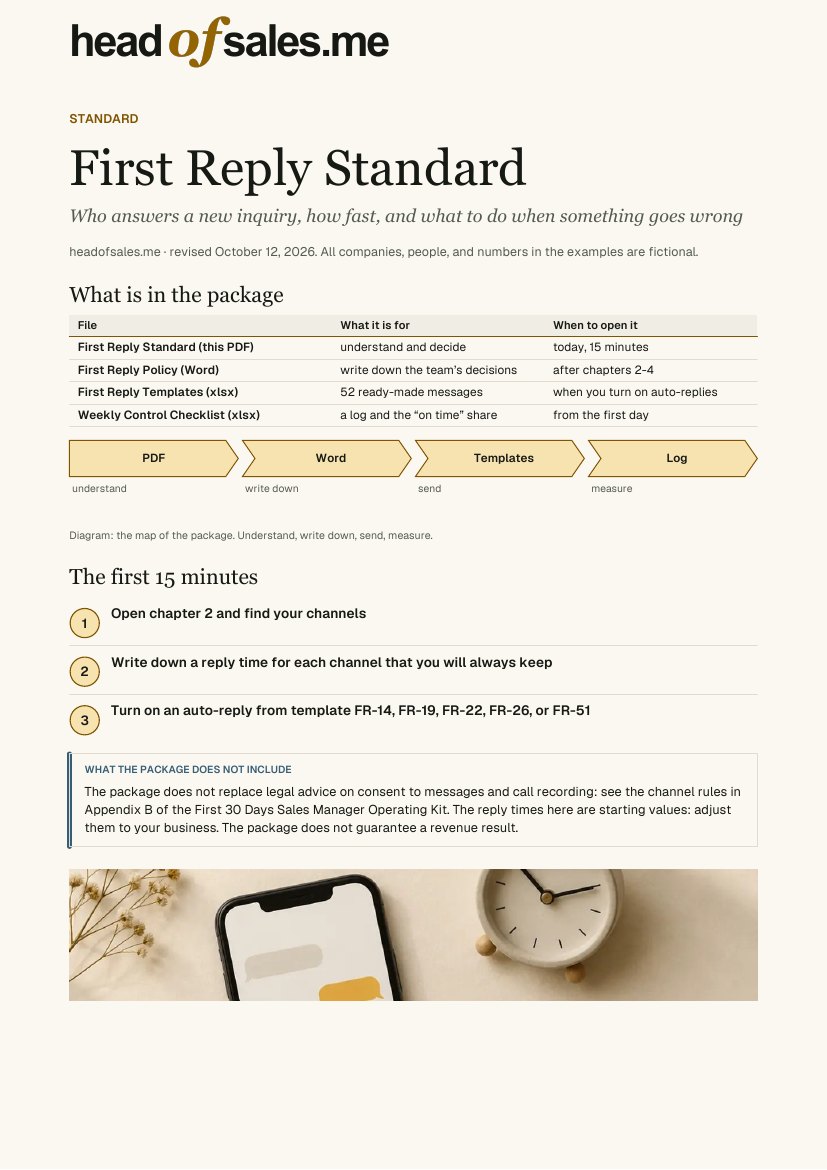
Who replies to a new inquiry, how fast and with which words. A policy, 52 reply templates and a weekly control checklist.