
Funnel (sales funnel)
The path of deals through the stages from inquiry to payment.
In plain words
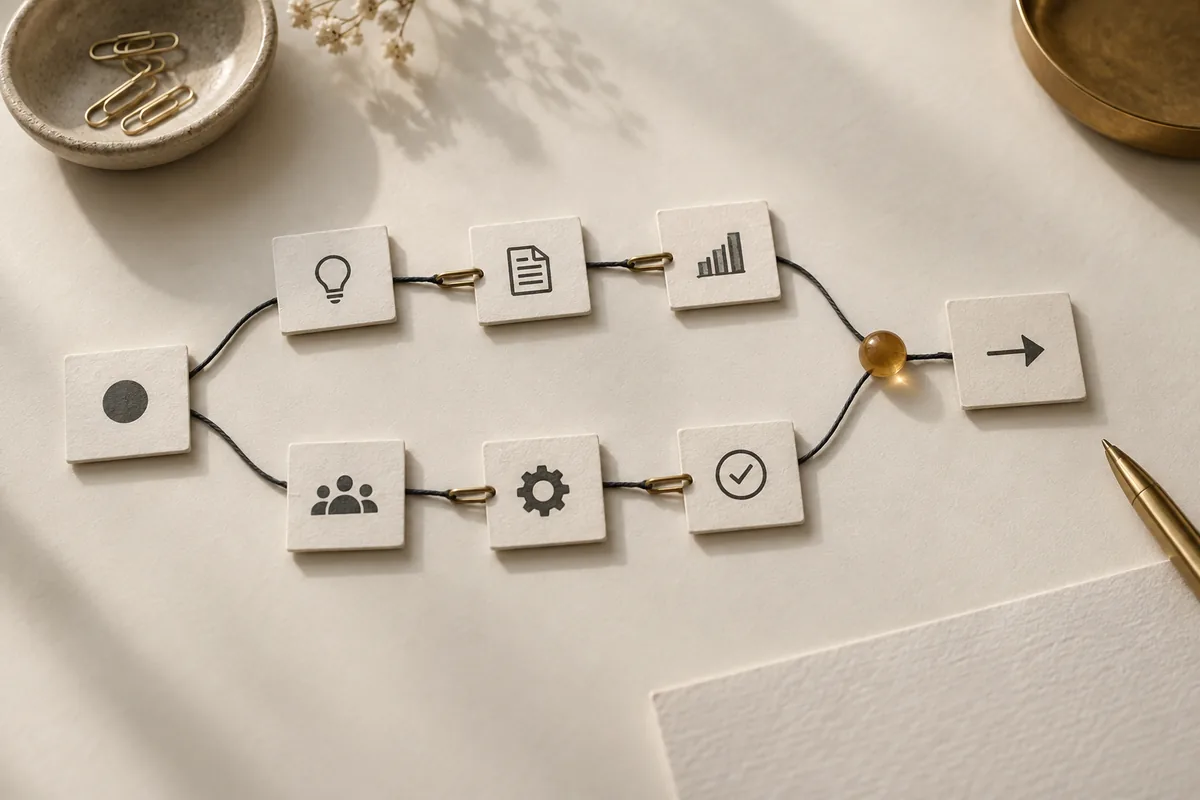
A funnel is all your deals laid out by stage: how many inquiries came in, how many reached a conversation, a proposal and a payment. It shows where deals stop. Each stage is narrower than the one before it, because at every step some customers drop out.
The numbers come from your CRM. Each deal sits in exactly one stage, so you count deals per stage for the same period. If your team works in a spreadsheet, one row per deal plus a “Stage” column gives you the same picture. Example (invented numbers): of 48 inquiries, 27 reached a conversation, 14 got a proposal and 3 bought.
Worked example (invented numbers)
Of 48 inquiries, 27 reached a conversation, 14 a proposal, and 3 bought.
How to use it
Look at the funnel once a week, at the same time and for the same period. The head of sales reads it before the weekly meeting. The owner reads it once a month. Skip the total at the bottom and look for the stage that got narrower since last week.
The funnel decides what you do this week. If conversations do not turn into proposals, you sit down and listen to calls. If proposals do not turn into payments, you look at prices and at how sellers follow up. Either way, you pick one stage to fix first.
Three neighboring terms help you read it. Conversion is the share of deals that moved from one stage to the next. The leak is the stage where conversion is lowest. Active deals are the ones with a recent reply and a dated next step. The rest only make the funnel look bigger.
Common mistakes
- Mixing periods. You count inquiries for this month and payments for last month, and the funnel lies. Count every stage for the same period, or follow one group of inquiries from start to finish.
- Counting dead deals as open. A deal with no contact for a month still sits in Proposal and makes the stage look full. Close such deals as lost, with a reason, before you read the funnel.
- Too many stages. Give sellers a dozen stages in the CRM and they stop moving deals correctly. Start with the stages a customer actually goes through: inquiry, conversation, proposal, decision, payment.
- Reading only the bottom line. The number of sales tells you what happened. It does not tell you why. Look at every move from one stage to the next.
Questions
What is a sales funnel in plain words?
The path of deals through the stages from inquiry to payment: how many reached a conversation, a proposal, a payment. For example, of 48 inquiries, 27 reached a conversation, 14 a proposal, and 3 bought.
NEXT STEP · TOOL
By Friday, the head of sales builds this month’s funnel from the CRM: one line per stage, the number of deals at each, the same dates for all stages. Before counting, close the deals with no contact for a month. Start with that cutoff and adjust it later. Show the funnel at the weekly meeting and ask the team where they think deals stop. Write down the stage they name and hold it up against the numbers.
CRM rules the team follows and a forecast review you can run every week.