
How to run a pipeline review in 45 minutes
Bring only the stuck deals and ask the same three questions about each. Every deal leaves with one decision: move it, fix it or close it. Write each decision as one line with an owner and a date, and open that list first next week.
What to bring to the room
Bring a short list of stuck deals. The full pipeline stays in the CRM, where anyone can read it before the meeting. Send the list to the sellers the afternoon before. Ask each of them to open their deals on it and note two dates: the customer’s last reply, and the decision date if the customer gave one.
Two minutes with a deal the day before turn a seller’s answer into one sentence. A seller who sees the deal for the first time in the room starts telling you its whole history. Have these on the table:
- The stuck list: the deals that match your written rule, pulled from the CRM the day before.
- Last week’s log. The first five minutes go to checking what was agreed.
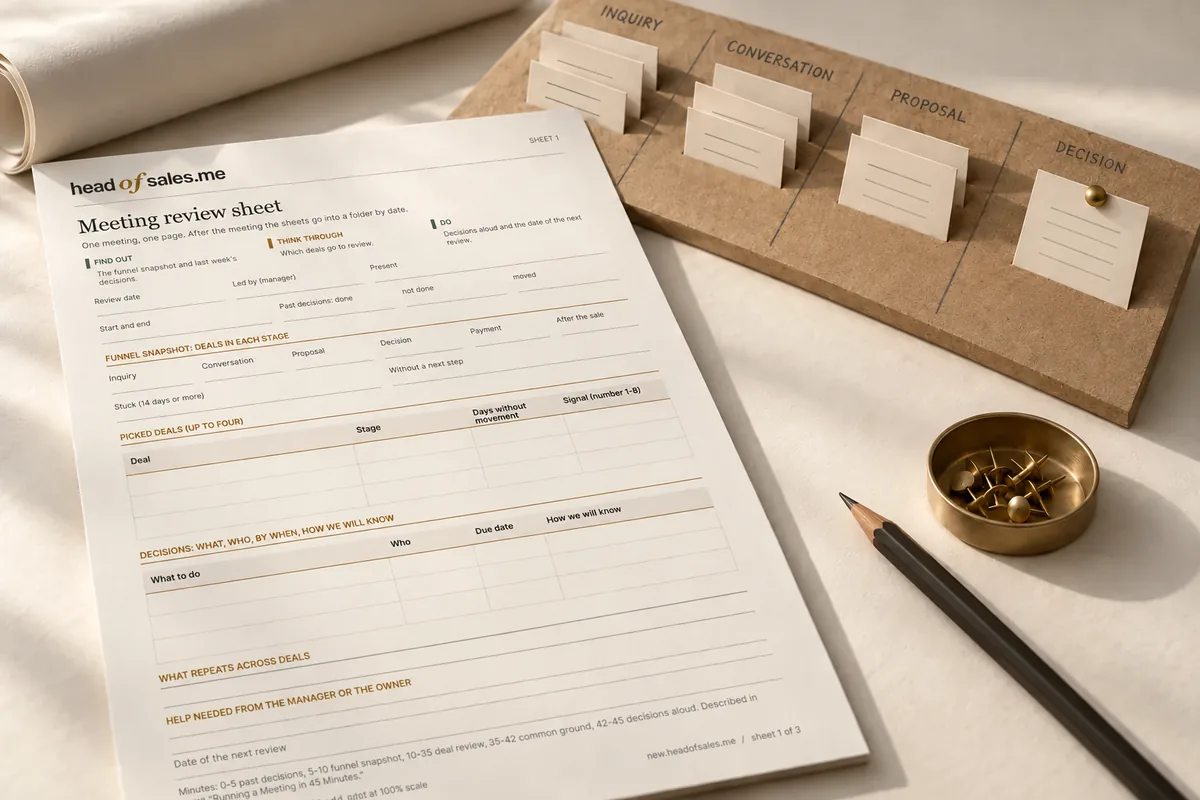
- One review sheet per meeting, printed or on screen, with four columns: deal, decision, owner, date.
- The CRM open on a shared screen, so steps go in during the meeting and nobody types them up afterwards.
How to choose the deals
A deal goes on the list when it has stopped moving. Write the rule down. Then the list comes from a CRM filter, and not from your memory of who sounded worried last week.
For a 45-minute meeting, start with a cap of seven deals and test it on your own team. If more qualify, take the seven stuck longest and send the rest back to their sellers: by Friday each one has a dated next step or is closed with a reason. Note the stage where stuck deals bunch up. That stage is often your leak. A list that grows every week means the problem sits earlier, in qualification or in how next steps are set, and no meeting fixes that on its own.
The two weeks in the rule below are a starting point. With a ten-day sales cycle they are too long; with a four-month cycle they may be too short. Pick a window that fits your cycle, keep it for a month, then adjust it once. A deal is stuck when any one of these is true:
- It has no next step, or the next step has no date.
- The next step is overdue.
- The customer has not replied for two weeks.
- The decision date has passed without an answer.
The 45 minutes, block by block
Ask three questions about each deal, always in this order. What should be true by now? What is true today? What one step would move it? Listen hardest to the second answer. A seller who cannot say what is true today has just shown you a deal nobody controls, and that is the most useful thing you will find in the hour.
Let the seller answer, and write while they talk. Once you start explaining how you would run the deal yourself, the other sellers stop thinking about theirs.
Keep the blocks in the same order every week. People prepare better when they know what comes next, and a fixed order stops the meeting from sliding into one long story about one deal.
- Minutes 0 to 5: last week’s log. The owner of each line says one word, done or not done. A line that is not done gets a new date or goes back on the list.
- Minutes 5 to 40: the stuck deals, about five minutes each, with the same three questions.
- Minutes 40 to 43: read the new decisions back aloud, line by line.
- Minutes 43 to 45: one pattern you noticed, and anything the owner of the business should hear this week.
Three decisions for every deal
Each deal on the list leaves with exactly one decision. Make it before you open the next deal, even when the talk feels unfinished. “Keep an eye on it” is not one of the options: it sounds careful and leaves the deal exactly where it was. A deal stays open only with a dated next step.
A deal that has been fixed twice without progress is closed the third time, or you take the next step yourself. Otherwise, pick one of these:
- Move it: one named action, one owner, one date in the calendar. The seller enters it as a task on the deal in the CRM before the next deal is opened.
- Fix it: the deal is missing something it cannot move without, such as the person who signs, an amount or a decision date. Name the missing piece, who gets it and by when. The deal comes back next week.
- Close it: mark it lost with a reason from your list of loss reasons. If the customer comes back, reopen it.
What to write down
Closing is hard the first few times, mostly for the seller. Tell them plainly why you do it: a deal nobody will touch this month inflates the forecast and hides the deals that need your attention. A closed deal with a clear reason is information you can use, and the log is where that information piles up.
One line per deal: deal, decision, owner, date, and the reason for closed deals. Write it in the meeting. A decision typed up afterwards is already your version of it, and the seller may remember a different one.
Keep every line in one log, a sheet or a saved CRM view, and never start a fresh one. After a month you can count the loss reasons that repeat and find the stage where stuck deals bunch up. Those two counts set next month’s agenda, and all they cost you is four weeks of short lines.
How to end on time
Stop at minute 45, even with deals left. The unreviewed ones go to the top of next week’s list, or into that seller’s one-to-one if they cannot wait. Let the review run over a few times and the team learns that the end time is a suggestion. A month later it takes 90 minutes.
Read the decisions back before anyone stands up, and have each owner confirm their line. Three minutes here save most of the “I thought you meant” conversations on Thursday.
Then write one sentence for the owner of the business: how many deals were closed, how much value left the forecast, which pattern showed up. If you would rather not build the sheet and the log yourself, the Pipeline review in 45 minutes kit has both, made for this meeting.
Where pipeline reviews go wrong
In the first month, while the habit is still setting, watch for these. Any one of them turns the review back into a status meeting.
- Status read-out. Every seller reads every deal. The moving deals never needed the meeting, and the stuck ones get the same minute as the rest.
- The manager solves the deal. You explain the play, the seller nods, and a week later everyone still treats the step as yours.
- Last week goes unchecked. If the log is not opened first, by the third week the team has learned that decisions are optional.
- Blame in the room. A seller with many stuck deals needs a private conversation. Move it to the one-to-one.
- Dates pulled forward. Sellers move decision dates into this month to keep a deal off the list. Each time a date moves, ask what the customer actually said.
An example with invented numbers
Example (invented numbers): a head of sales with four sellers has 46 open deals. The stuck filter returns 11. She takes the seven stuck longest and sends the other four back to their sellers with a Friday deadline.
In the meeting, three deals are moved, each with a task and a date in the CRM. Two are fixed: one has no decision date, and on the other the seller has never spoken to the person who signs. Two are closed as lost, one with “no decision maker reached”, the other with “postponed to next year”.
The two closed deals were worth $31,000. Before the meeting, open pipeline for the month was $180,000 against a $60,000 target, a coverage of 3.0. After it, $149,000, a coverage of about 2.5. The number is lower and closer to the truth. She sends it to the owner on Friday.
The next review opens with five lines from the log. Four are done. The fifth, a fix, gets a new date, and she writes down that if it comes back a third time, she will make the call herself.
Do this week
This week, the head of sales writes down the stuck rule, pulls the list from the CRM on Tuesday and runs the first 45-minute review on Wednesday with the log open on screen.
A weekly meeting on stuck deals that ends with a decision and an owner for each.