
How to set up a weekly sales rhythm
Start with one 30-minute weekly meeting, a short set of numbers with written definitions and a list of decisions with owners and dates. Keep exactly that for four weeks. One-to-ones come in the second month, and anything else after them.
What a weekly rhythm is made of
A weekly rhythm is a short list of things that happen on the same day, at the same time, and leave something in writing. That written result is what makes it a rhythm: the decisions, owners and dates the next meeting checks before it adds new ones. A meeting without them is a conversation that happens to repeat.
For a team of one to ten sellers, the full version has four parts and fits on one page. You will not start with all of them. The page only shows where you are heading:
- One weekly team meeting with numbers and stuck deals.
- A short set of numbers, each with one definition.
- A one-to-one with each seller.
- A short note to the owner of the business at the end of the week.
Start with one weekly meeting
Choose one slot and protect it, for example Monday at 10:00 for 30 minutes. Early in the week leaves time to act on what you find. Put it in every calendar for the next eight weeks before the first one happens.
Run it in the same order every time. The numbers come first, five minutes, read without discussion. The stuck deals get the biggest block, fifteen minutes: about five minutes a deal, so the three stuck longest, with one decision for each. The last ten minutes are for decisions and owners: last week’s list first, done or not done, then the new decisions, each with one owner and one date.
A topic that does not fit gets its own slot later in the week, and the meeting does not grow to hold it. Thirty minutes that always end on time are easier to keep than an hour that sometimes runs to two.
Pick a few numbers and define them once
Start with seven numbers at most. Choose ones the team can change this week. Revenue arrives only at the end of the month, so it goes in the monthly report, with win rate, pipeline coverage and the median sales cycle.
Write one sentence per number: what it counts and which CRM field it comes from. For example: “Sales: a deal counts on the date of its first payment, never on the date the contract was signed.” Without that sentence one seller counts a chat as a conversation, another counts only calls, and the meeting spends ten minutes on whose number is right. The Seven weekly numbers kit has a short numbers agreement the team settles together.
Decide who pulls the numbers and by when: you, by 9:30 on Monday, from saved CRM filters, together with the stuck list. The seven for a team of one to ten sellers:
- New inquiries: new requests and messages, each inquiry counted once.
- Reply on time: inquiries answered within your standard, divided by all inquiries.
- Conversations and meetings: held, not just scheduled.
- Proposals: sent in writing, with a price and terms.
- Deals with a step and a date: open deals with a next step and a due date recorded, divided by all open deals.
- Sales: count and amount, by the rule you agreed, by payment or by signed contract. Do not mix them.
- Overdue: actions whose due date has passed.
Add one-to-ones in the second month
A seller brings to the one-to-one what the team meeting cannot hold: a deal that worries them, a call that went badly, a skill they want to practice. It runs 30 minutes, in the same slot every week or every second week, and ends with one action the seller finishes before the next one.
Read the CRM before you go in, so the seller does not have to recite statuses. If the one-to-one keeps turning into a deal-by-deal update, the team meeting is not doing its job. Fix that meeting first.
Wait until the team meeting has held for a month. Start both at once and the team has twice as much to get used to. When something slips, you will not know which part caused it.
The order of the week
Monday sets the week and Friday closes it. Something urgent that comes up on Wednesday waits for the next slot, unless a customer is waiting too.
Once the meeting and the one-to-ones are both in place, a small team’s week can look like this. Move the days to fit your sales cycle and your customers, then keep them fixed.
- Every morning: ten minutes alone with three CRM lists. New inquiries without a reply, deals without a next step, deals whose decision date has passed. You run this check yourself, and nobody else attends.
- Monday: numbers ready by 9:30, team meeting at 10:00 for 30 minutes.
- Tuesday to Thursday: one-to-ones, spread out so that no single day is full of them.
- Wednesday, from the third month and only if you need it: a separate 45-minute pipeline review, once the stuck list keeps holding more than the three deals that fit into fifteen minutes.
- Friday: one page to the owner with the numbers, the forecast and the open questions.
Keep one meeting for a month and add nothing
The first month has one goal: four meetings, on time, in the same order, each checking last week’s decisions before it writes new ones. That is the whole plan. Hold off on the extra Wednesday check-in and the new report template, even when they look useful.
Every new ritual takes attention from the first one, and a busy team keeps fewer habits than you expect when you plan them. The meeting has become a habit once it survives a hard week and a week when you are away. Then add the next part.
Keep a plain record: the date of each meeting, how long it ran, how many of last week’s decisions were done. After four weeks those lines show whether the rhythm is real.
When the rhythm slips
The first missed meeting usually ends the rhythm, because it tells everyone the slot is optional. Decide these cases before they happen:
- If you are away, a seller runs the meeting in the same order.
- If the numbers are not ready, meet anyway and say which ones are missing and why.
- If the meeting runs over twice, hold the stuck-deal block to the three deals stuck longest.
- If decisions keep coming back undone, write fewer of them. Two that happen beat six that get discussed.
An example with invented numbers
Example (invented numbers): an owner who sells, with three sellers, starts a Monday meeting at 10:00. In week one the numbers are 41 new inquiries, 29 of them answered on time, 12 conversations and meetings, 6 proposals, 23 of 38 open deals with a step and a date, 2 sales for $8,000 and 9 overdue actions.
The meeting ends with four decisions. By the next Monday three are done and the fourth gets a new date. In week three the owner is traveling, and the most experienced seller runs the meeting from the same sheet. It ends on time.
After four weeks the record shows four meetings, an average length of 32 minutes and 13 of 16 decisions done. Overdue actions went from 9 to 4. In the second month the owner adds a 30-minute one-to-one with each seller on Tuesdays and Wednesdays, and nothing else.
Do this week
This week, the head of sales books one 30-minute Monday meeting for the next eight weeks, writes a one-sentence definition for each of the seven numbers by Friday and runs the first meeting next Monday.
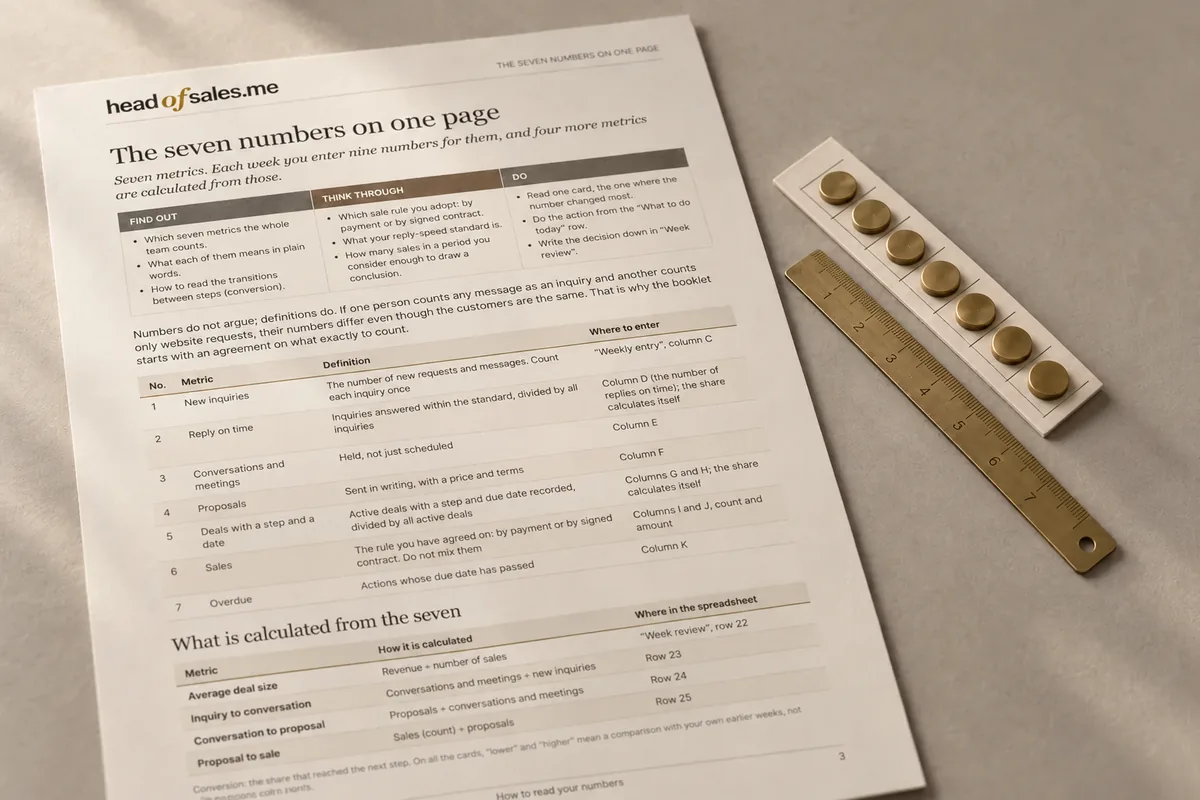
Which numbers to check every week, with one definition for the whole team.