
What goes on a weekly sales meeting agenda?
Keep it to 30 minutes in a fixed order: numbers for five minutes, stuck deals for fifteen, decisions and owners for ten. Read the same seven numbers, decide on the deals stuck longest, then check last week's decisions and write the new ones with an owner and a date.
The agenda in three blocks
Hold it on the same day and time every week, in the same order: numbers, stuck deals, decisions. People prepare for what they know is coming, and the meeting stops growing. Write the agenda at the top of the meeting notes so it is there every time.
- Numbers, 5 minutes: the same seven, for the team and for each seller, read without discussion.
- Stuck deals, 15 minutes: about five minutes each, so the three stuck longest on the CRM list, one decision each.
- Decisions and owners, 10 minutes, starting with last week's list: read each line and ask, done or not done.
- Then today's new decisions: read back each one with its owner and date.
Which numbers to bring
Bring the seven numbers the team can change this week: new inquiries, reply on time, conversations and meetings, proposals, deals with a step and a date, sales and overdue. Revenue arrives at month end and says little about what to do on Tuesday.
Read the numbers here and argue about them later. If one seller counts a conversation differently, the meeting loses ten minutes. Write one sentence per number saying what it counts; the Seven weekly numbers kit has a ready agreement for this. A number that looks wrong becomes a decision: who checks it, and by when.
Which deals go on the list
Pull the list from a saved CRM filter on Monday morning, together with the numbers. It holds deals with no next step or no date on it, deals with an overdue step, deals where the customer has been silent for two weeks, and deals whose decision date passed without an answer. Deals that moved this week stay off the agenda.
Fifteen minutes hold about three deals at five minutes each, so take the three stuck longest. Each one gets one decision. Move it with a new step and a date, fix what is missing and name who fixes it, or close it as lost with a reason. When someone says “let's keep an eye on it”, hand it back to the seller as a question: what will you do, and when? The rest of the list goes back to the sellers: by Friday each deal has a dated next step or is closed with a reason.
What to leave out
Leave out the read-out where every seller goes through every deal. Coaching one seller on one call belongs in a one-to-one. A pricing debate that needs an hour gets its own slot, and the meeting stays at 30 minutes. When the stuck list stays longer than three deals for weeks, plan a separate 45-minute pipeline review on Wednesday, once the weekly meeting and the one-to-ones have settled.
If you are away, a seller runs the meeting with the same agenda. If the numbers are not ready, meet anyway and say so. Skip one week, and the team learns the meeting is optional.
An example with invented numbers
Example (invented numbers): four sellers meet on Monday at 10:00. The CRM list has seven stuck deals, four without a next step and three with a passed decision date. The three stuck longest get the fifteen minutes: one gets a new step and date, one a fix and an owner, and one is closed as lost. The other four go back to their sellers with a Friday deadline. Last week left five decisions: four are done, and one moves to Thursday with a reason. By 10:30 the decision list has seven new lines: three decisions and four deals handed back with Friday as the date.
Do this week
On Friday, write the three-block agenda at the top of the meeting notes and save the CRM filter for stuck deals, so the list is ready with the numbers by 9:30 on Monday.
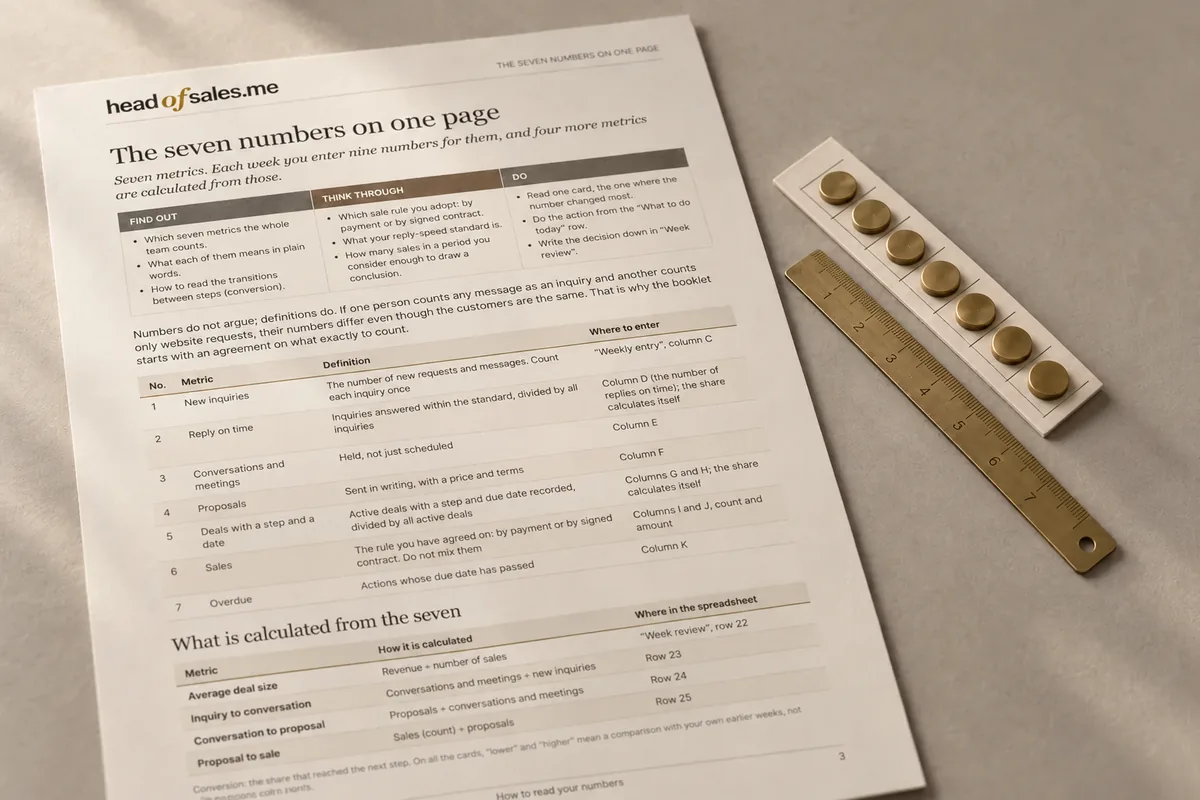
Which numbers to check every week, with one definition for the whole team.