
What to write in a first reply policy
A first reply policy fits on one page. Each channel gets its working hours, its reply time, the person who replies, the backup and the after-hours rule. Below that you write what counts as a reply and what the first message contains, and how the team checks the policy every week.
What goes in the policy
Write one line per channel, because a phone, a messenger and email work differently. Then add the rules that hold for every channel. For a team of three to ten, it all fits on one page:
- The channel and the working hours it covers.
- The reply time: how soon a person answers, per channel.
- Names: who replies in this channel and who covers when they are away. Use names, because a role does not answer the messenger at lunch.
- After hours: when the clock stops and when the customer gets a reply.
- What counts as a reply, and what the first message says.
- How the policy is checked: which numbers, on which day, and who looks at them.
Say what counts as a reply and what it says
A reply from a person counts. An automatic “we got your message” does not stop the clock, because the customer is still waiting for a person. Keep the autoreply anyway: it shows the channel works. Decide in writing how to count a “we will call you back later” and a question sent in return, so two sellers do not count the same thing two ways.
Next, the first message itself. It answers the customer's question, or asks one useful question when the inquiry is unclear. It carries the name of the person writing and proposes a next step, a call or a meeting at a set time. You want a booked conversation, because that is the moment an inquiry leaves the first stage. A sticker or a “hello?” tells the customer nothing, and the clock keeps running.
You do not have to write the wording from scratch. The First reply standard has 52 reply templates for typical inquiries and an editable first reply policy, so the team uses the same words from day one.
Write down how it is checked
Each week, read two numbers per channel. One is the share of inquiries answered within the policy, the Reply on time number on the weekly page. The other is the median reply time: use the median, since one slow reply drags an average up. Count inquiries with no reply on their own line.
Once a week, go through the misses with the people who reply and ask what happened each time. Most answers point to a gap in cover, at lunch, in the evening or on a sick day. Close it by writing a name into the policy. Shorten the reply time only after the current one has held for a month.
An example with invented numbers
Example (invented numbers): a team of four writes a policy for three channels. Messenger: one hour, weekdays from 9:00 to 19:00, Maria replies and Oleg covers. Email: four working hours, Oleg replies and Maria covers. Website form: one hour, same people as the messenger. Anything that arrives after 19:00 gets a reply by 10:00 the next morning. In the first week, 50 of 62 inquiries, 81%, were answered on time. Seven of the twelve misses came in at lunch, so the policy now names a lunch cover.
Do this week
By Wednesday, find the median reply time per channel for the last two weeks and write a one-page draft with names. On Monday, agree it with the people who reply.
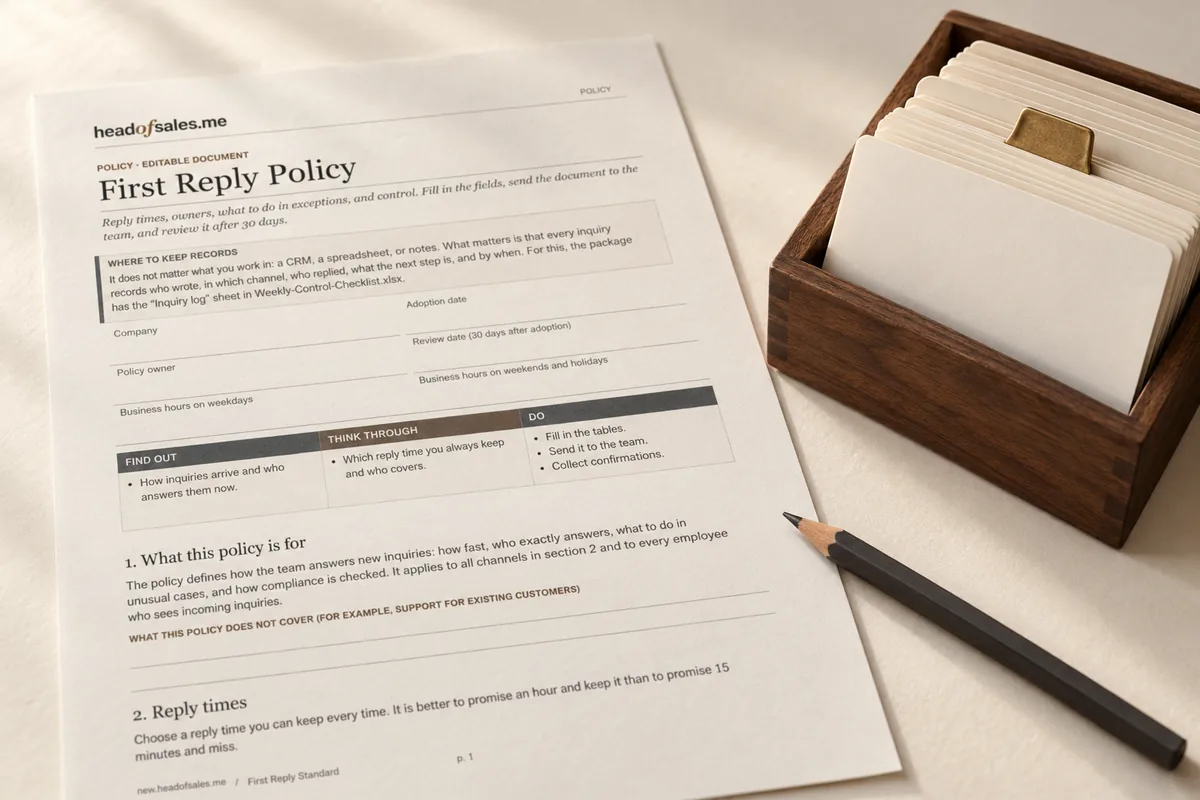
Who replies to a new inquiry, how fast and with which words.