
How long should a one-to-one be?
Start with 30 minutes, once a week, at the same time for each seller. Once a seller is settled, or the team grows past eight, meet every second week. Each one-to-one ends with one action the seller finishes before the next.
Why 30 minutes is a good start
Thirty minutes holds one real topic and still fits into a busy week. Book an hour, and the meeting gets moved the first time a customer calls. Book fifteen minutes, and it ends just as the seller gets to what is actually bothering them.
Treat the 30 minutes as a starting point and test it. Run the format for a month, then ask each seller one question: was the time too short, too long or about right? Change one thing at a time.
How often to meet
Meet weekly with a new seller, and with everyone in a team of up to five. Move to every second week when a seller knows the product and their deals run without daily help. Keep the same slot each time, for example Tuesday at 10:00 for one seller and 10:30 for the next.
With more than eight sellers you cannot meet everyone weekly and still do the rest of the job. Rotate: half the team one week, the other half the next. Tell the team how the rotation works, so nobody decides they were skipped.
Cancel rarely. If you have to, move the meeting the same day and name the new time. A seller reads a cancelled one-to-one as a message about where they stand.
What fits in half an hour
Leave deal status out. You read it in the CRM before the meeting, about ten minutes per seller. The half hour is for what the CRM cannot hold: a deal that worries the seller or a call that went badly, and now and then a skill they want to practice.
Start with a plain question, such as which deal worries you most this week, or what you need from me. Then wait. The first answer is usually the polite one, and the second is the true one. The One-to-one meetings kit has 120 more questions: pick one or two and leave the rest.
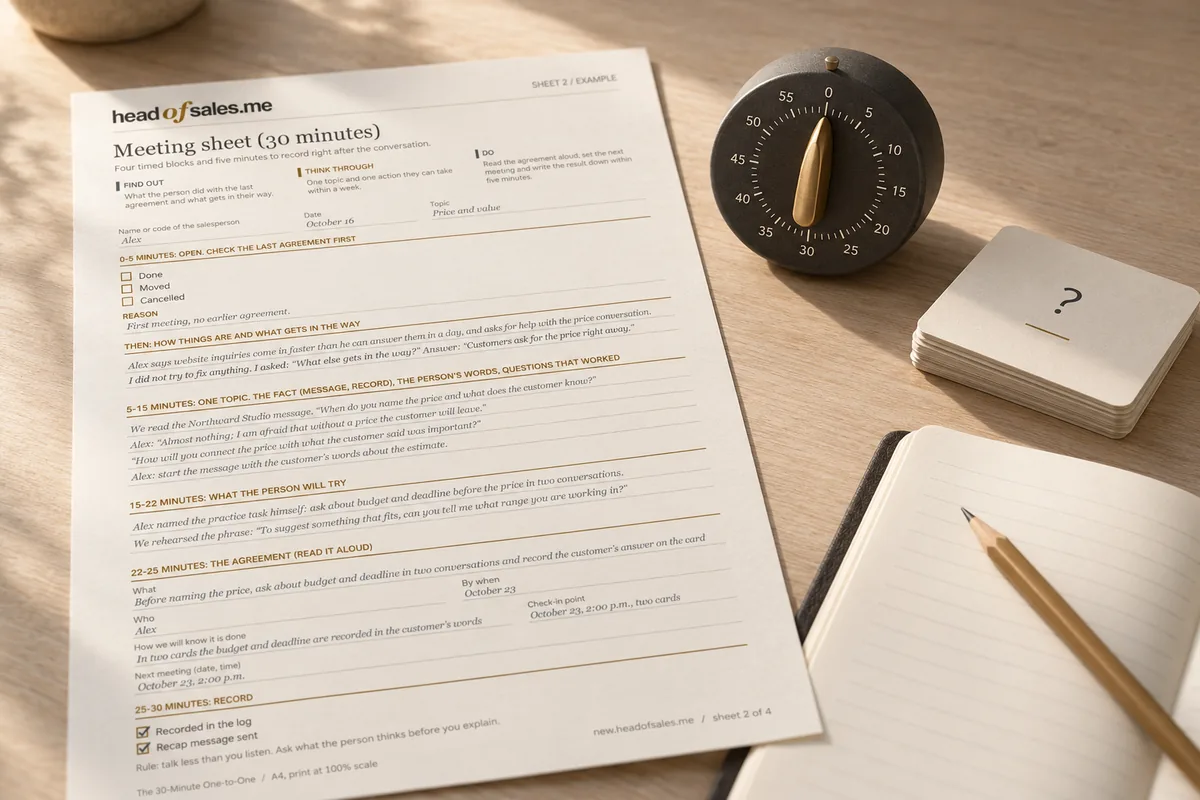
- Minutes 0 to 5: the action from last time, done or not done.
- Minutes 5 to 20: the seller's topic.
- Minutes 20 to 25: one thing you noticed, said plainly.
- Minutes 25 to 30: one new action, written in shared notes with a date.
End with one written action
What the seller walks out with matters more than the minutes. Each one-to-one ends with one action small enough to finish in a week, written as a task: what, who, by when. The next meeting opens with it.
After a month, check two things: are the actions getting done, and does the seller bring their own topics? Two yeses mean the length works. If you keep running out of time, status updates have crept back in: move them to the CRM before you add minutes.
An example with invented numbers
Example (invented numbers): a head of sales has six sellers. The two who joined this quarter get 30 minutes every week. The other four meet every second week, two of them each Tuesday. That is four one-to-ones a week, two hours in total, plus 40 minutes of CRM reading beforehand.
Do this week
By Friday, book a recurring 30-minute one-to-one with each seller for the next four weeks: weekly with new sellers, every second week with the rest.
A 30-minute one-to-one with each seller, with an agenda and 120 questions to pick from.